
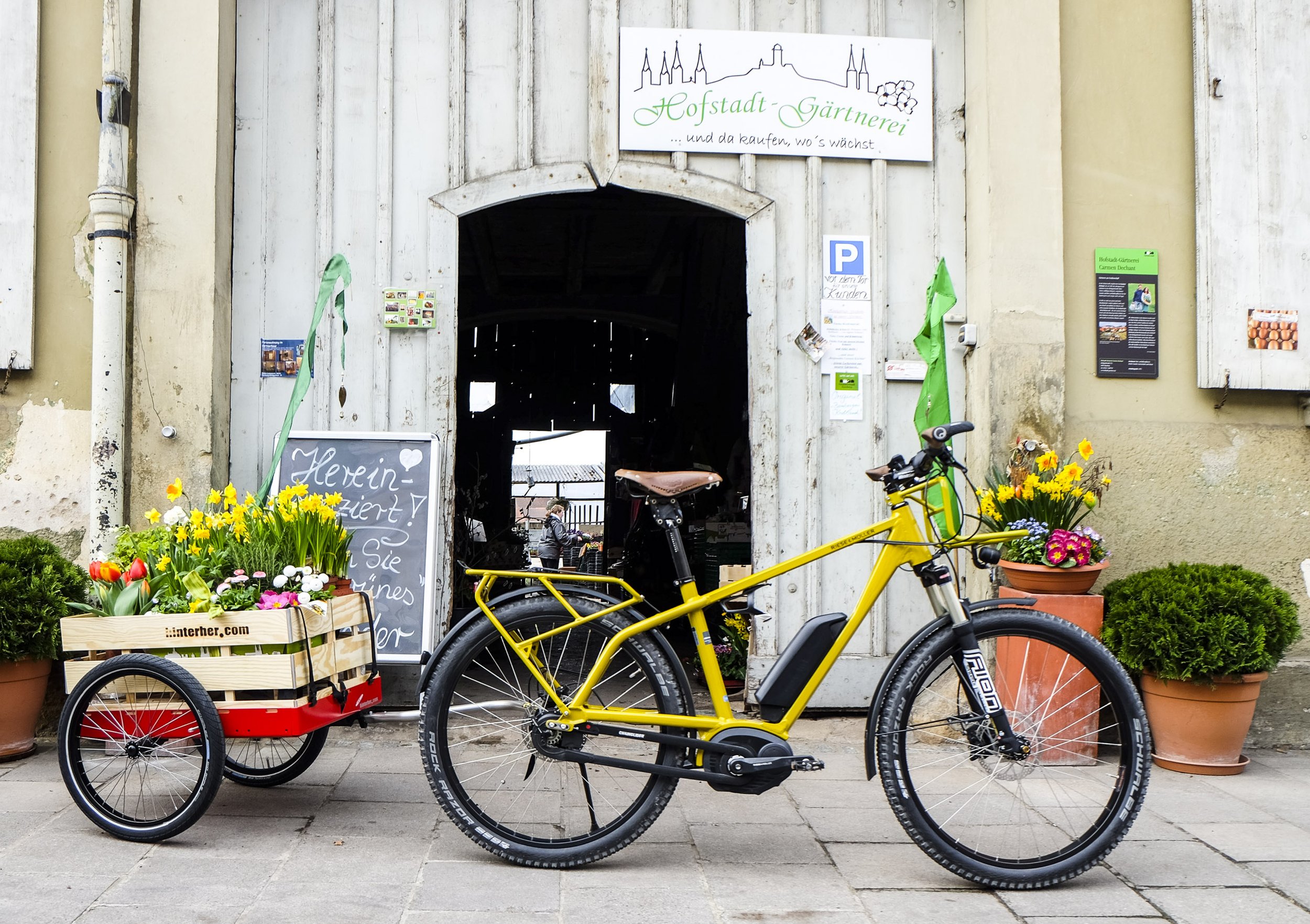
Bike Trailer Guide
How do I find the right bike trailer for hauling cargo? Which trailer do we recommend for grocery shopping, and which one for bike tours? On this page, we’ll try to give you a few tips on how to find the right bike trailer. Feel free to contact us by phone or email with any questions.
Table of Contents
What would you like to transport?
Draufsicht, maßstäblich. Die Höhe der Ladung ist nicht dargestellt. Auf gute Lastverteilung achten.
Ladung
Anhänger
Deichselverlängerung
passtpasst nicht
Ergebnis
Consider the intended use
Take a moment to think about what you’ll mainly be using the trailer for. Is there a specific item you’ll want to transport frequently, and how big is it? This could be a toolbox, a travel bag, a box, a dog, or something else. Or maybe you’d like to use the bike trailer mainly for grocery shopping. In that case, you can consider how large your groceries are or whether you’ll need to transport large, bulky items, such as cases of drinks. Our simulator lets you try out different items on various trailer sizes.
Try out the size at home
Do you have specific items—or boxes, crates, and bags—that you want to fit on a bike trailer, and do you want to see what all can fit on a particular model at once? Then try it out at home: mark off an area on the floor the size of one of our trailer models and load your items onto it. Do you have to stack them too high? If so, the trailer is probably too small.
Real-world examples from the customer gallery
In our customer gallery, you can see hundreds of examples from everyday life showing all the different things people transport with our bike trailers. Thanks to our filter, you can view examples for specific models or search by topic:
What equipment do I need?
1. How much weight can my bike trailer carry?
Our bike trailers can be configured with different load capacities. In most cases, the standard configuration is well-suited to the trailer’s size and typical intended use. The larger the trailer, the more robust the standard configuration tends to be. In our configurator, you can select drawbar and coupling systems with higher load capacities. We also offer reinforced wheels there.
If you plan to frequently exceed the maximum weight specified in the standard specifications for the respective model.
If you plan to use the bike trailer almost every day or for commercial purposes.
If you spend a lot of time driving on rough roads or are going on a long trip.
You need an upgrade
2. Do I need suspension on my bike trailer?
It depends. Our suspension system lets you do two things: comfortably transport fragile items or your dog, and ride the bike trailer more easily. With our suspension system, you’ll hardly have to restrict yourself while riding, and that really pays off if you ride the trailer a lot.
Long suspension travel for the worst roads

Hydraulic damping for smooth driving

Adjustable weight ranges

3. Does my bike trailer need an overrun brake?
Most likely not. We only recommend our overrun brake for commercial use, especially when consistently transporting very heavy loads with powerful e-bikes. Of course, there are other situations where an overrun braking system makes sense, such as in specific terrain or if regulations require it above certain weights, which we fortunately managed to prevent in Germany.
We have continuously refined our overrun braking system over many years. It is now in its third and completely revised generation. It stands out for its high functionality, compact design, and very easy maintenance.
-
An overrun brake is a technical device on the trailer that automatically brakes it without any action from the rider, when the towing bicycle decelerates strongly enough. The bicycle stops, but the trailer still wants to move forward, and it's precisely this 'forward movement' that allows the trailer to essentially apply its own brake. This is a great feature, especially since heavy trailers can push quite a bit from behind when braking. An overrun brake is therefore a significant safety advantage for certain uses. However, it's important to know that an overrun brake does not automatically reduce the load on the bicycle's brakes. The overrun brake only detects that it should also brake when the bicycle brakes strongly enough. If the overrun brake mechanism were set too softly, the brake would activate in unwanted situations, as there are constant speed differences between the bicycle and the bike trailer during riding.
-
This question isn't so easy to answer, because the total weight of the bike trailer and its load is just one factor to consider. Other factors include your speed, the terrain, your own weight, how often you use the trailer, and your general willingness to adapt your riding style to the conditions. As a general rule, however, you can safely ride a trailer that is rarely loaded with heavy weights (i.e., 80–100 kg) as long as it has good bicycle brakes and you ride carefully.
-
We have conducted extensive in-house braking tests with our bike trailers. In doing so, we have determined that several factors are crucial for safely braking a bike trailer. First and foremost are proper riding technique and good technical equipment. In addition, the ratio of rider weight to trailer weight is critical. If you and your bike weigh at least as much as the entire bike trailer, you can safely stop the bike trailer using good bike brakes. We tested speeds of 15 km/h and 25 km/h. Of course, when riding on public roads, you must always take into account the prevailing conditions, such as road surface, weather, and traffic.
It becomes a problem when the bike trailer is significantly heavier than you and your bike combined. In that case, it will push you away when you brake. Nevertheless, almost all bike trailers in Germany seem to operate without any issues even without a trailer brake. Furthermore, bike trailers haven’t appeared in accident statistics for decades. If you ride sensibly and appropriately, you can accomplish a lot with bike trailers while staying safe on the road.
-
The total weight of the bike trailer plays a role in deciding whether an overrun brake is absolutely necessary for a bike trailer. However, we believe this question is not the most important one. More crucial for everyday use is how often very heavy loads are transported and at what speed. Private users of a bike trailer usually have less time pressure than commercial users. They can occasionally ride their bike trailer slowly and carefully with 80 or 100 kg without an overrun brake, for example, when moving or transporting heavy items to bulky waste collection. It goes without saying that one should ride more cautiously in such situations. Commercial users should also adjust their riding, as all components will be excessively stressed if they speed over sidewalks or potholes with a full load. But those who are constantly on the go professionally with a heavy load and a powerful e-bike cannot and do not always want to ride slowly. For precisely this target group, an overrun brake is a safety advantage and an investment that is proportionate to the intensity of use.
-
In January 2024, we learned that the federal government was planning to tighten the STVZO regulations regarding bicycle trailers. According to these plans, bicycle trailers with a total weight of 50 kg or more would be required to have an overrun braking system. We mounted a high-profile public campaign in collaboration with industry associations and cycling forums to oppose this completely nonsensical and unnecessary tightening of regulations. And we were successful. Committed cyclists supported us with a petition; the press reported on our efforts, and the Ministry of Transportation backed down. You can download our comprehensive statement from that time here:
. The 2024 news section includes a detailed summary of the events:
. You can read press coverage here:And here you can read the discussions in the forum community:
Model recommendations
Everyday use,
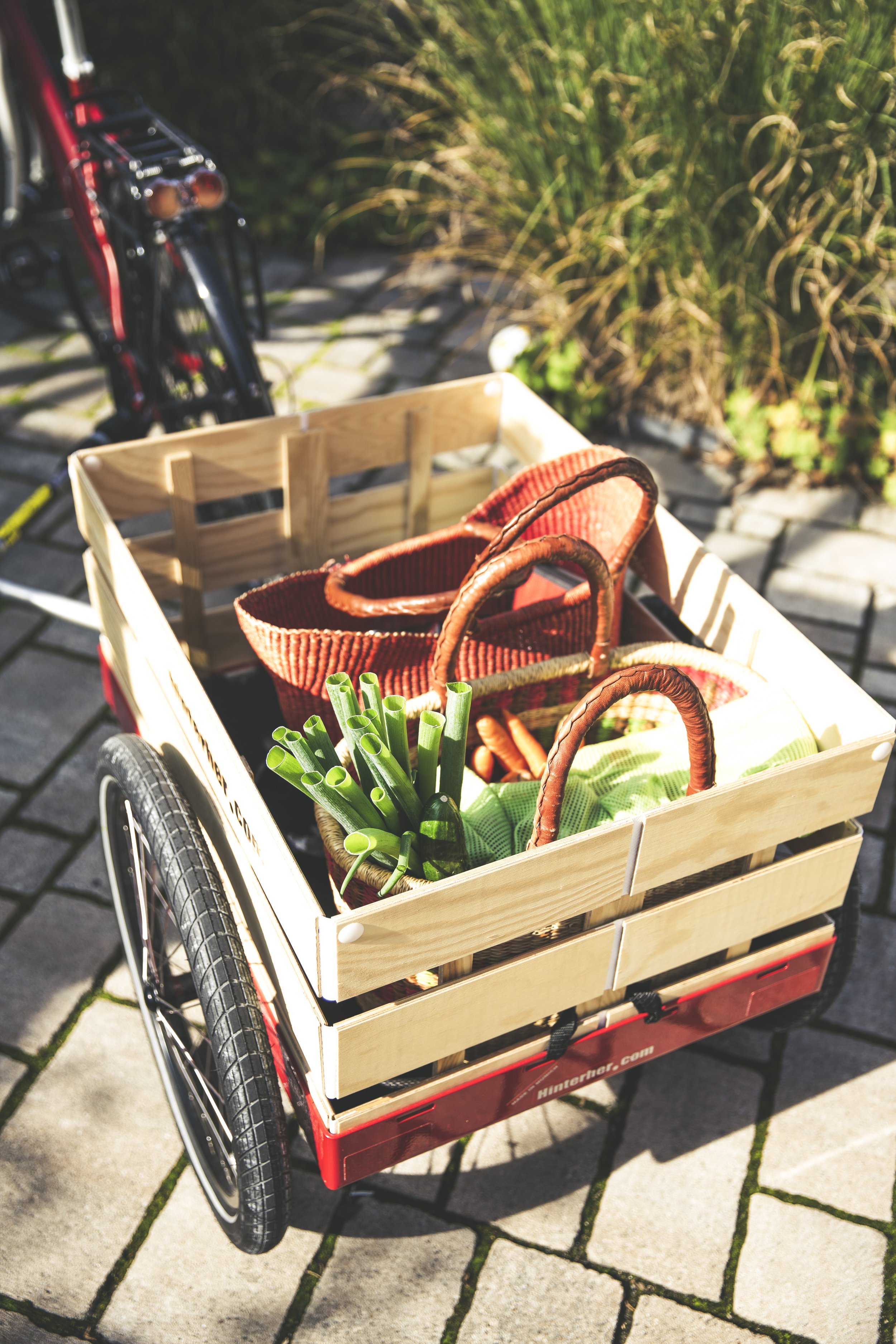
Shopping,
Tours
Hmax / Hmax
This model offers a great balance of transport capacity, low weight, and everyday usability thanks to its relatively manageable size. It can fit two crates of beer or several small cases of water side-by-side. With a little improvisation, you can transport a Christmas tree just as easily as a child's bike. Garden waste or even a small dog also fit on it without any problems.
Family,
Crafts,
Garden
Hxxl / Hxxl light
If you often need to do a lot of shopping or transport larger items, we recommend our Hxxl or Hxxl light bike trailer. Its loading area is designed to fit two Euroboxes side-by-side (and they can be stacked on top of each other). Euroboxes are 60x40 cm plastic boxes widely used in industry and warehousing. Despite its considerable load capacity, the Hxxl is no larger than a two-seater child trailer, making it completely practical for everyday use.
Professionals,
Frequent cyclists,
Large dogs
Hxxxl light
No matter what you want to transport, it will most likely fit on this ingenious bike trailer. The Hxxxl light strikes a balance between everyday practicality and amazing transport capabilities. It remains light enough to be carried around and used even without an e-bike. It can accommodate large dogs, three Euroboxes, or bulky items. It is no wider than a two-seater child trailer, making it completely easy to use in road traffic and on bike paths.
Information stand,
Public relations,
Associations
Market stall with umbrella
This mobile information stand can be easily transported anywhere by bike and quickly transforms into an eye-catching and attractive information stand.
Brompton,
Folding bike,
Train travel
Hmini
Our smallest bike trailer is a perfect match for the Brompton. It can be 'folded' even faster than the original English model and turns the Brompton into a small workhorse.
KEP,
Last mile,
Commercial use
Box trailers
Our box trailers are available in various sizes and offer unbeatable value for money for professional goods transport. They have been successfully used for many years in the toughest delivery operations.
Custom builds
Thanks to our globally unique modular system, we can cost-effectively adapt a wide range of bike trailers to individual requirements.
Which hitch system fits my bike?
Which clutch fits my bike? We get asked this question every day in emails and over the phone. If you don’t want to dig deeper into the subject, feel free to send us a photo of your bike or e-bike. You can find our contact information here. Please take a photo of your bike’s rear wheel from the side—not at an angle from the front or from the back. Please don’t take the photo too close; we’d like to see a little bit of the rest of the bike as well, especially the kickstand.
For anyone who wants to delve a little deeper into the subject, we've created a derailleur finder. Here you'll find a guide to help you determine which Weber derailleur fits which bike. Generally speaking, there are two main locations where a derailleur is typically mounted on a bike.
Mounting the hitch on the rear wheel axle
The rear wheel axle is the most popular location for mounting a hitch. Many hitch systems on the market are only available in a version designed specifically for this type of mounting. This includes typical bike trailers from hardware stores, as well as almost all child bike trailers. Depending on whether the bike has a derailleur gear system or an internal hub gear system, the hitch is clamped onto the quick-release axle or the solid axle of the hub gear. The hitch is held in position solely by the clamping pressure of the quick-release skewer (for derailleur gears) or the cap nut (for hub gears). Only the Weber hitch offers a safeguard to prevent the hitch from rotating around its own axis. For this reason, the Weber hitch is also a bit more specialized when mounted on the rear wheel axle compared to the common hitches from child bike trailer manufacturers. The reason is that the Weber system is designed for a towing weight of up to 100 kg. This is significantly more than all hitch systems for child bike trailers or inexpensive 'China trailers'.
Die Besonderheit der Weber-Kupplung: Das Sonderpolygon
Wird die Weber-Kupplung auf der Hinterradachse montiert, so wird zuerst eine Unterlegscheibe mit einer hervorstehenden “Nase” auf die Hinterradachse gesetzt. Diese kleine “Nase” der Unterlegscheibe wird dabei in den Schlitz des Fahrradrahmens geschoben. Diesen Ort am Fahrrad nennt man auch Ausfallende. Weil sich die Unterlegscheibe dank der Nase nun im Fahrradrahmen verklemmen kann, kann sie sich nicht mehr um die Hinterradachse drehen. Sie bleibt also immer in Position. Das ist gut so, denn auf ihrer nach außen zeigenden Seite hat diese Unterlegscheibe eine eckige Verzahnung. In genau diese Verzahnung verzahnt sich dann die eigentliche Weber-Kupplung mit ihrem Blechteil und ist somit ihrerseits gegen das Verdrehen um ihre eigene Achse gesichert. Diese Unterlegscheibe, die bei Weber als “Sonderpolygon” bezeichnet wird, ist mit dafür verantwortlich, dass die Weber-Kupplung ein so robustes und hoch-belastbares Kupplungssystem ist. Denn beim Bremsen und Anfahren mit einem schweren Fahrradanhänger wird permanent an der Fahrradkupplung gezerrt oder geschoben. Der Fahrradanhänger möchte die Kupplung eigentlich immer um die eigene Achse verdrehen.
Sonderpolygone für alle Fälle
Nun gibt es von Seiten der Fahrradhersteller unendlich viele Möglichkeiten, wie sie im Detail ein Fahrrad bauen können. Manche Hersteller bauen den Fahrradrahmen so, dass die Hinterradachse regelrecht nach innen zurückgesetzt wird. Das ist für die Montage der Weber-Kupplung ein Problem, denn die Weber-Kupplung benötigt ein paar Zentimeter Platz, um sich seitlich schräg nach unten zu entfalten. Hier darf sie nicht sofort auf Rahmenrohre treffen. Aus diesem Grund gibt es von Weber verschieden dicke Sonderpolygone, die dabei helfen, die Weber-Kupplung sehr weit nach außen zu versetzen. Benötigt man ein solches Sonderpolygon, dann ist meistens auch die vorhandene Schnellspannachse zu kurz. Hierfür gibt es bei uns im Sortiment eine verlängerte Schnellspannachse.
Sonderpolygon für Nabenschaltungen
Besitzt dein Fahrrad oder E-Bike eine Nabenschaltung, z.B. eine Enviolo, Shimano Alfine oder Nexus (Rohloff ist ein eigenes Thema), dann benötigst Du ebenfalls ein ganz spezielles “Sonderpolygon”. Der Grund dafür ist einfach: Die Nabenschaltung benutzt bereits eine eigene Unterlegscheibe mit einer kleinen “Nase”, die in den Rahmenschlitz des Fahrrads gesteckt wird. So sichert sich das Teil der Nabenschaltung, was sich nicht mit dem Laufrad dreht, gegen sein eigenes Verdrehen. Im Rahmenschlitz (oder Ausfallende) des Fahrrads ist aber immer nur Platz für eine dieser speziellen Unterlegscheiben mit “Nase”. Die Lösung: Die Firma Weber bietet ein Sonderpolygon an, welches auf der innenliegenden Seite die Nabenschaltung gegen ihr Verdrehen sichert und auf der außenliegenden Seite die Weber-Kupplung. Dieses “Sonderpolygon für Nabenschaltung” ist genau auf dein vorhandenes Schaltungssystem abgestimmt. Hier findest Du mehr Informationen dazu.
Die Montage der Weber-Kupplung auf dem Fahrradständer
Man kann eine Fahrradkupplung nicht nur auf der Hinterradachse montieren, sondern auch auf dem Fahrradständer, wenn sich dieser in der Nähe der Hinterradachse befindet. Es gibt zwei Industriestandards bei Fahrradständern. Schau einmal nach: Ist der Ständer an deinem Fahrrad mit zwei sichtbaren Schrauben direkt im Rahmen verschraubt? Super, dann ist es fast immer möglich, die Weber-Kupplung direkt zusammen mit dem Fahrradständer zu montieren. Entweder sind die beiden Schrauben des Fahrradständers 18 mm (Weber EP Kupplung oder Weber EU Kupplung mit Distanzhülsen) oder 40 mm (Weber EH Kupplung) voneinander entfernt. Fast alle Fahrräder mit einer Rohloff Speedhub Nabenschaltung verfügen fast immer über einen dieser beiden Ständerstandards. Ansonsten verfügen viele Fahrräder mit Rohloff-Schaltung auch über verschiebbare Ausfallenden, zum Spannen der Kette. Auch für diese verschiebbaren Ausfallenden gibt es von der Firma Weber eine spezielle Kupplung (Weber ER).
Mein Fahrrad hat eine Steckachse. Welche Kupplung passt?
Immer mehr moderne Pedelecs, Mountainbikes oder Gravelbikes besitzen keinen klassischen Schnellspanner mehr, sondern eine sogenannte Steckachse. Es ist als Laie gar nicht so einfach zu erkennen, ob man eine Schnellspannachse (dünn) oder eine massive Steckachse (dick) am Fahrrad verbaut hat. Denn die eigentliche Achse ist von außen nicht sichtbar. Man sieht nur den Hebel, um die Schnellspannachse zu lösen bzw. um die Steckachse herauszuschrauben. Aber wenn Du genau hinschaust siehst Du, dass die Steckachse komplett von dem Fahrradrahmen umgeben ist. Hier gibt es keine offenen Schlitz im Rahmen, indem das Laufrad sitzt. Die Steckachse sieht so aus, als hätten Sie ein Loch mit der Bohrmaschine in den Rahmen gebohrt. Das Loch wird komplett vom Rahmen umschlossen.
So viele Vorteile Steckachsen beim Fahrrad und Pedelc auch haben mögen, für die Montage einer Fahrradkupplung sind sie leider eine teure Herausforderung. Man kann die Steckachse nicht einfach aus dem Rahmen herausschrauben, eine Kupplung durchfädeln und alles wieder draufschrauben. Die Steckachse wäre dann zu kurz. Deshalb haben die großen Hersteller von Kinderanhängern verschiedene Varianten von Steckachsen im Sortiment und es gibt auch einen tollen Drittanbieter, der verschiedene Steckachsen anbietet. Für die Montage der Weber-Kupplung eignen sich diese speziellen Steckachsen allerdings nicht. Denn wir erinnern uns: Die Weber-Kupplung muss aufgrund ihrer großen Belastbarkeit gegen das Verdrehen um ihre eigene Achse gesichert werden. Deshalb baut auch hier die Firma Weber ihre eigene Steckachse. Diese ist an ihren Enden auf zwei Seiten abgeflacht und darauf kann sich die Weber-Kupplung wiederum elegant gegen ihr eigenes Verdrehen sichern. Um die richtige Weber-Steckachse zu finden, musst Du die Gewindesteigung deiner bisherigen Steckachse herausfinden. Diese ist direkt auf der Steckachse selbst eingraviert. Wir helfen dir ansonsten gerne weiter.
Lastenfahrräder, Falträder, Hinterradmotor - Welche Kupplung passt?
Bei manchen Fahrrädern oder E-Bikes ist es mituntern schwierig, eine Weber-Kupplung zu montieren. Aber wir finden fast immer einen Weg. Ob Lastenfahrrad (Bullitt, Tern GSD, Urban Arrow, Douze, Muli, Chike), Faltrad (Brompton, Birdy) oder Fahrräder von Vanmoof, Cowboy oder Schindelhauer: An alle diese Fahrräder haben wir schon Weber-Kupplungen geschraubt. Eine Herausforderung sind mitunter moderne Pedelecs mit einem Hinterradmotor (Neodrive, Mahle, Goswissdrive, Bafang). Hier ist die Hinterradachse meistens mit 12mm sehr dick und es gibt kein spezielles “Sonderpolygon” von der Firma Weber, welches auch auf die Verdrehsicherung des Motors abgestimmt wäre. Kontaktiere uns in diesem Falle gerne mit Fotos.