
Our new suspension system
Whether over curbs, cobblestones, or forest trails: our newly developed suspension system confidently compensates for even rough bumps—for significantly more comfort and fun while riding.
Not every bike trailer needs suspension—many of our models perform excellently without it. However, in some situations, high-quality suspension opens up entirely new possibilities:
Maybe you want to transport your dog safely and comfortably? Or protect delicate items like musical instruments, camera equipment, or measuring devices? Or maybe you just want more freedom while driving—no matter how rough the road is?
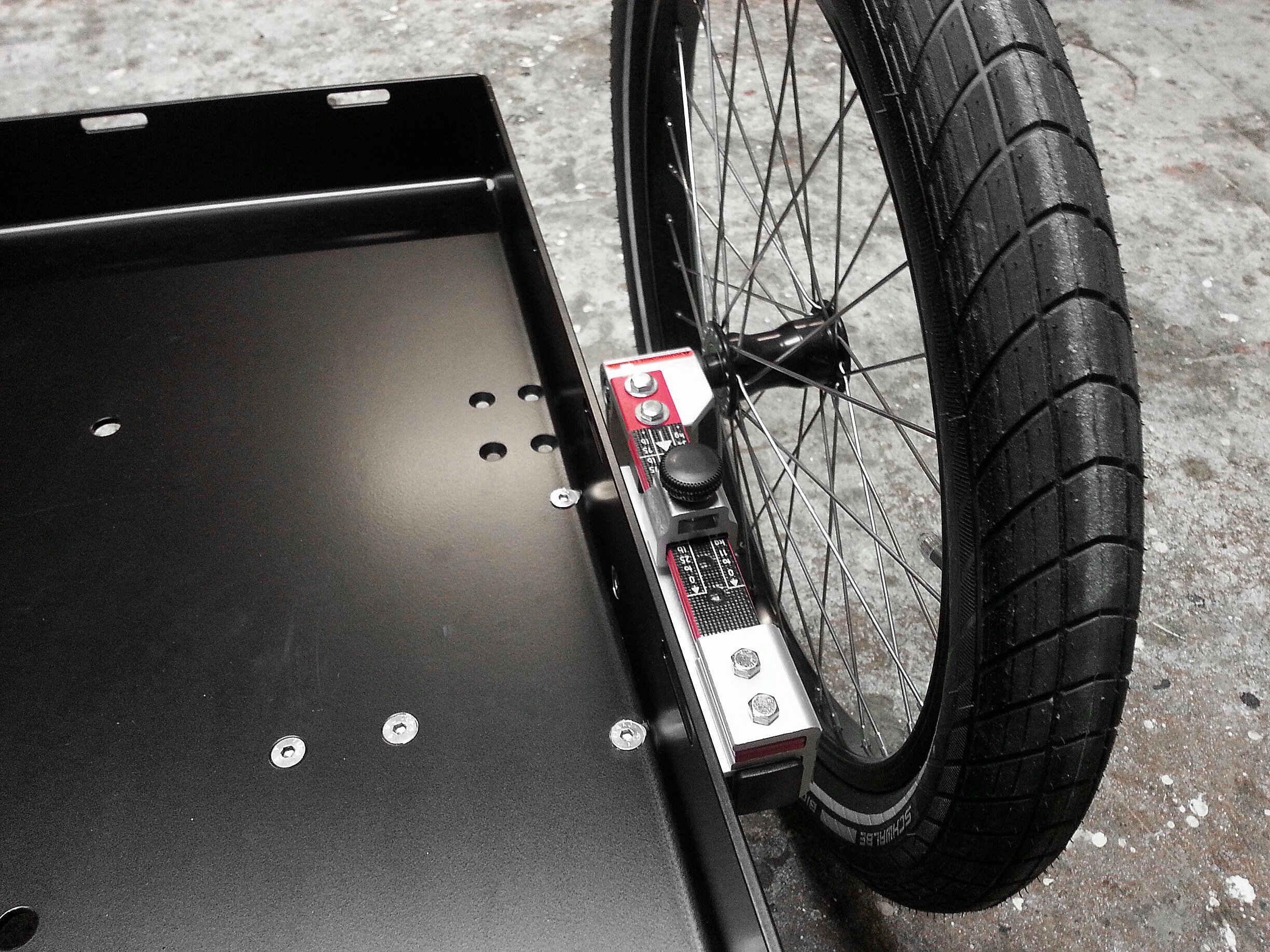
This is precisely why we developed our suspension: in a long, complex development process together with two experienced vehicle engineers and Munich University of Applied Sciences. The result is a heavy-duty suspension with long travel, linear spring characteristics over the entire travel range, and genuine hydraulic damping—for optimum handling on any surface.
Whether small or large, lightly or heavily loaded—our suspension system is compatible with all our models. We’d be happy to advise you personally by email or phone.
Our suspension offers an enormous 90 mm of travel. This gives it plenty of reserves on any terrain and with varying loads.
suspension travel
Our suspension features genuine hydraulic damping, a rarity in bicycle trailers. This ensures a particularly smooth ride, without any swaying or rocking.
attenuation

Our suspension can be optimized for three weight ranges in seconds. For even more performance and driving pleasure.
adjustability
Our suspension can handle a total weight of up to 100 kg. This means that even large loads can be transported smoothly over poor bike paths or to remote locations.
resilience
Most trailers use elastomer dampers, which only work well within a small weight range and quickly harden beyond that, especially under increasing loads. Our linear suspension, on the other hand, remains evenly active throughout the entire suspension travel.
Constant spring characteristic


Our suspension is located on the underside of the trailer to save space. This means that the trailer is only slightly wider. The entire loading area and chassis width remain available. This allows the trailer to fit through anywhere while still offering enough width for standard boxes.
Minimum possible construction width
Technical data
Independent suspension with steel spring element and hydraulic damper.
Components made of high-strength aircraft aluminum, CNC-milled.
Continuous stainless steel axle for load distribution across both wheels.
High-quality plain bearings from IGUS.
90 mm effective spring travel across the entire load scenario.
Linear spring deflection behavior of the steel spring: The entire spring travel is fully available.
3 installation positions for the steel spring element: soft, medium, hard. Can be adjusted in seconds using an Allen key and open-end wrench.
Removable wheels with thru axle and safety clamp.
Total system weight: approx. 2.5 kg
Can also be retrofitted and is available for DIY installation
Designed for a total weight of up to 100 kg (trailer weight including load)
From €648 incl. VAT for the complete chassis including stainless steel axle.
Can be combined with any Hinterher with 20" wheels (except H2O). With 16" wheels (Hmini), ground clearance is slightly restricted.
Price
You can select the suspension for each model in the configurator . The suspension is also available as a complete set in our online store for retrofitting or DIY projects.
Order

FAQs on suspension
-
In principle, there are various design approaches for suspension systems on trailers. However, they often do not deserve the name because they are merely elastomer-based dampers that are compressed under increasing loads and lose a large part of their spring effect.
They are all designed to cushion the impact of driving over obstacles as much as possible and protect sensitive loads (e.g., children, animals, measuring instruments, photographic equipment, or musical instruments). When a spring-loaded trailer drives over an uneven surface, the suspension allows the wheel to move upward, preventing the entire trailer from being shaken. The difficulty lies in adjusting the suspension to the extremely different load weights that can occur in a trailer. A trailer with a total weight of 100 kg has to withstand five times as much load as a small dog trailer with a total weight of 20 kg. It can therefore be said that the spring hardness must be adjustable in order to function at all in different load scenarios. We were able to solve this problem elegantly by making it possible to simply screw the spring into place for three different weight classes in a matter of seconds.
In principle, there are also different types of suspension elements. We opted for a standard suspension element with hydraulic damping that has proven itself in the bicycle market. Although it is not as inexpensive as an elastomer or leaf spring, it can cover a completely different performance spectrum. This performance spectrum is necessary because bicycle or dog trailers are loaded and used in extremely different ways. Even when unloaded or carrying little weight, the suspension should function just as well as when fully loaded. This requires a certain amount of effort in the design. That is why we rely on a very long spring travel, which provides enough reserves for fluctuating load weights and can continue to utilize the remaining spring travel evenly even when overloaded. In addition, the suspension can be adjusted by the user in a matter of seconds by moving the spring element.
-
When driving over an uneven surface, the wheel is pushed upward and wants to spring back down (using the energy of the compressed spring), ready for the next obstacle. Therefore, the main task of a good suspension system (also in cars or motorcycles) is to dampen the backward movement in order to prevent the trailer from rocking uncontrollably and to ensure responsiveness for the next obstacle.
However, there are virtually no child trailers, dog trailers, or cargo trailers that have actual damping built in. Neither elastomer suspensions nor leaf suspensions provide real damping in bicycle trailers. Here, a certain degree of deceleration occurs more by chance and more poorly than well due to friction and the inertia of the built-in systems.
In contrast, our high-quality suspension system incorporates a spring damping element that can perform all these tasks perfectly. -
Elastomers are very popular as suspension elements in bicycle trailers, mainly because they are inexpensive. However, they have many disadvantages, which is why they are hardly ever used in bicycle chassis. As the load increases, they behave progressively, i.e., they harden as the load increases, so that the spring effect decreases significantly. They have no damper and only comparatively low inherent damping, which means they cannot achieve a long spring travel. However, precisely because bicycle trailers have a very large load range, from unloaded to heavily loaded, a long suspension travel is very important. This provides extreme reserves and a large range in which the suspension can work optimally. Instead of cheap elastomers as suspension elements, we rely on a component that has proven itself in the bicycle sector for decades: a steel spring element with hydraulic damping.
-
Some manufacturers use leaf springs. Put simply, the wheel is attached at the end to several metal strips that lie on top of each other and are held together with a variably positionable clamp. The wheel bends upward with the leaf spring when it encounters an obstacle. However, the leaf spring stores this deformation energy extremely well and returns it to the wheel immediately once the obstacle has been passed. Without damping, the wheel oscillates back and forth until the energy is used up or the next bump or pothole is encountered. There is virtually no effective damping, only the friction and inertia of the components.
-
No, the suspension does not require intensive maintenance. The steel spring itself is maintenance-free, but the hydraulic damping is a wearing part in the long term and may need to be replaced after many years. The trailer would still remain roadworthy (with suspension, but without damping). However, this component can be replaced at any time. After a few years, the high-quality, maintenance-free plain bearings from market leader IGUS may also need to be replaced, but these are also standard wear parts.
-
For sensitive loads, such as animals, musical instruments, photographic equipment, etc., we would generally recommend good suspension. Anyone who transports sensitive loads or simply wants to ride more carefree will benefit from a suspension system, because the numerous shocks that the bike trailer has to endure on inadequately developed bike infrastructure are hardly transmitted to the bike anymore. This not only protects the load, but also the material.
But not all suspension systems are created equal. We would not overestimate the effectiveness of a primitive suspension system on a cheap trailer, and it is certainly no better than a large-volume tire that is driven with relatively low air pressure. For most users who need a simple, robust, and easy-to-maintain trailer, this would also be our recommendation for everyday use. A truly high-quality suspension system comes at a price and definitely makes the bike trailer more technically complex. Even with an unsuspended bike trailer, you can easily cope with everyday use. We fit large-volume tires from Schwalbe as standard, which can already compensate for many small vibrations. If necessary, simple damping can be achieved by adjusting the air pressure for different load weights.
However, if you often ride on rough roads, you will need to ride more slowly and carefully with an unsuspended bike trailer. With a suspension trailer, you can ride much faster and more carefree. Even if you ride longer distances and tours, our high-quality suspension clearly makes riding more enjoyable and is easier on your equipment and your nerves.
-
Yes, this is possible in principle and can also be done yourself. To do this, the existing axle with brackets must first be removed. Additional holes must be drilled in the floor panel of the aluminum chassis for the new suspension system. This is not particularly difficult if you are reasonably handy. Our suspension system can also be used on homemade bicycle trailers or bicycle caravans. It is important to have a sufficiently rigid and stable base plate.
When ordering as a DIY kit, it is essential to specify the outer width of the trailer chassis so that we can adjust the length of the stainless steel axle to your trailer.
Making of suspension
We have never invested so much development time and resources in a new component. Hinterher Peter Hornung explains why this is a financial risk—and whether he himself drives with the new suspension.

Johannes: When did you first come up with the idea of developing a suspension system for your cargo trailers?
Peter: That was actually relatively early on. I think we had just started building the first series trailers—maybe in 2013 or 2014. And it seemed obvious to take a look at what suspension systems were already available. We looked at the technology used in children's trailers and started testing it on our trailers.
Johannes: And? Did it work?
Peter: Yes and no. It worked somehow, but the quality wasn't up to the standard we need for our trailers. The suspensions in child trailers are designed for a few dozen kilograms and relatively gentle use. But we wanted a solution that would still work reliably with a hundred-kilogram payload—and last for as many years as possible. It quickly became clear that this wasn't going to work.
Johannes: What exactly was missing?
Peter: Stability, suspension travel, real damping—the whole package, really. Most existing systems don't have any real damping, and the suspension consists only of rubber blocks or elastomers that are simply compressed. Even torsion axles, which are used by very few manufacturers, are based on compressed rubber cords that have less and less spring action under higher loads. This may be just about okay for transporting children weighing up to 45 kg, but for cargo trailers with completely different weights – sometimes 10 kg, sometimes 90 kg – you need a system that performs well across the entire range and simply has greater suspension travel.

"We realized relatively quickly that developing our own suspension system to meet our requirements was a step too far for us—at least at that time."
Johannes: And then the plan was: We’ll just build it ourselves?
Peter: No, we put that on hold for a while. We realized pretty quickly that developing our own suspension system to meet those requirements was a bit too much for us—at least back then. You don’t just need a good idea; you also need expertise, testing facilities, and manufacturing concepts. That would have simply been too much for us financially back then, especially since bike trailers work just fine without suspension. So we put the suspension idea on hold for the time being.
Johannes: And how did it come about that you ended up doing it after all?
Peter: The idea never completely went away, and it was partly because of you, Johannes, since you kept bugging me about it (laughs). We also kept getting customer inquiries about transporting photography equipment, sensitive testing equipment, or musical instruments—for which good suspension can definitely be useful. And then there were customers who claimed that all other manufacturers also had suspension on their trailers. We always had to explain that not all suspension systems are created equal, and that practically no suspension system on the market could withstand what our trailers are put through. Suspension systems are always heavily advertised on bike trailers, but—like many other components—they’re often so rudimentary that you could never, ever have offered something like that on a bicycle decades ago, let alone on a motorcycle or even a car. In any case, the topic came up again a few years ago, and by then we’d also learned from experience that price plays only a secondary role for customers who actually need something like this. This meant that the commercial success of such a new system “someday” was actually conceivable.
Johannes: How much effort did the development require?
Peter: It was the longest, most complex, and most expensive development of a single component we’ve ever undertaken. We brought in external engineers from the automotive industry for the development, and Munich University of Applied Sciences also supported us with a team of students. Still, the whole project would never have been feasible if we hadn’t handled the bulk of the design, prototyping, testing, and so on ourselves. And here, we had a truly talented industrial designer on our team in Samuel Simoni, who immersed himself in the project with great skill and perseverance.
Johannes: What were the requirements for the suspension system?
Peter: It had to be able to withstand a lot. Long suspension travel was important so that there would still be room to spare even with a heavily loaded trailer—as is the case with all our components. And it simply had to be adaptable to the wide variety of trailers in our lineup, which come in very different sizes and thus have different payloads. So it should be fairly easy to adjust the suspension to different weight ranges.
"From a business perspective, what we did was, quite frankly, bordering on insanity."

Johannes: At first glance, that sounds like a manageable set of specifications.
Peter: (laughs) On paper, perhaps. The theoretical concept of the suspension was relatively simple. But then you get bogged down in endless details: How do you manufacture it? How does it fit on different trailers? How can you assemble it? How can you simplify components? How can you manufacture it more cheaply, but still with higher quality and greater load capacity? And each of these aspects influences the others. You can solve one question and then realize that everything else has shifted.
Take the assembly alone: there are sequences here that you can't break out of; they are technically and geometrically predetermined. You can't tie the bow first and then put on the shoe. And that has a huge impact. You can't weld anything if you want to install plastic plain bearings. Otherwise, they'll just melt away. And even without that, welding causes a lot of warping. So everything had to be screwed or plugged together—and still be super stable. How do you do that? How do you achieve the necessary tolerances between the various manufacturing specialists? And so it goes on and on. Hundreds of hours spent optimizing manufacturing and assembly. And, of course, it has to look right too. If you're going to go to such immense lengths, then the suspension has to look good in the end.
Johannes: How many prototypes did you need before it worked?
Peter: Four completely different series. And in some cases, we even built them with our suppliers so that we could work directly with real tolerances on the high-performance CNC machines. You can simulate a lot or, like me, mill and turn yourself, but when it's actually assembled, you notice what doesn't fit. As I said, there are always conflicting goals somewhere: material, weight, stability, cost, function, assembly...

Johannes: And all that as a small company, without its own development team...
Peter: Exactly, that's another point that shouldn't be underestimated. On the one hand, all of this is happening in parallel with the usual production madness, especially in the post-corona years. And from a business perspective, what we've done is, quite frankly, bordering on insanity. We've developed a high-end chassis for a product that's produced in much smaller quantities than in the bicycle industry or by car manufacturers. But we didn't want a half-baked solution, we might as well have given up – after all, we have our reputation as the market leader for high-quality cargo trailers to uphold.
Johannes: What does the suspension look like now?
Peter: We have a linear steel spring element with hydraulic damping – this is technology familiar from bicycles, but adapted to our requirements. And with a characteristic curve that really works the same across the entire spring travel. This is extremely important when the load changes. Progressive suspension systems – such as those that work with elastomers, for example – simply have their limits. If you load it too much, the spring is basically "closed," nothing works anymore, and in practice, they can't utilize their theoretical total spring travel nearly enough. Especially where you would need it most.
Johannes: So elastomers were never an option?
Peter: No, they were out of the question for us. You can influence them a little bit via the geometry, but basically they remain progressive in character – and in our opinion, that's simply not suitable for cargo trailers with fluctuating loads. Progressive suspension works on bicycles because you always have the same body weight. But with cargo trailers, you load the trailer with something that exceeds the small ideal range of progressive systems, and then you hardly have any suspension effect. Here, we wanted the large working range of a linear system, because the loads can be 5 to 8 times higher than the trailer's own weight. With cars, it's the other way around, as the car itself always weighs significantly more than the payload.

“Everything has to fit together. What good is a great suspension system if the rest of the trailer consists of nothing more than a few flimsy tubes and fabric?”
Johannes: Did you have any role models?
Peter: Not exactly—this is actually a completely new development. But, for example, our VSF colleagues at Toutterrain have done a great job with this. They build single-track trailers with high-quality suspension technology from the bicycle industry—that’s impressive, and it definitely works, at least within the limits permitted for this type of trailer. It’s technically a bit different from what we do, but comparable in terms of the underlying concept. And it’s great to see that something like this can also be implemented in the trailer sector if you’re serious about it. We’ve also exchanged ideas on suspension technology with HP Velotechnik, who are also colleagues from the VSF association. Of course, we’re also familiar with all the other suspension systems from current bicycle trailer manufacturers—their strengths and, above all, their weaknesses—otherwise we wouldn’t have gone to all this trouble to develop something new.
Johannes: Are you satisfied with the result?
Peter: Absolutely. It took a long time, it was exhausting, with numerous extra rounds we had to go through, and we learned a lot. But now we have a system that meets our standards—and that we can release with a clear conscience. And the best part is: It looks great and can be retrofitted to just about any of our trailers. Even the very first prototype could run on it.
Johannes: Did you patent the suspension?
Peter: Yes, we have. But I can’t imagine who would even try to copy it. Even for ambitious DIYers, this is a few sizes too big—no one has that kind of machinery or the know-how for all the manufacturing steps at home. And competitors would have to copy not only this suspension system but also all the other parts we’ve developed in the meantime just to catch up with us when it comes to trailers of this size. And then they’d also have to come up with their own innovations—not just shoddy copies, like we see time and again at trade shows and online. In the end, everything has to fit together. What good is a great suspension system to me if the rest of the trailer is just a few flimsy tubes and fabric? That would be completely out of proportion. I wouldn’t go around bolting a Fox suspension fork onto a rickety old bike from the train station, after all.
Johannes: Would you personally install the suspension on your Hxxxl Light?
Peter: Not on the Hxxxl I use most often, at least not right now. I’m all about super-robust and simple tech, and I need to be able to take the trailer apart quickly. But luckily, I’m right at the source and can use a suspension-equipped trailer from our fleet at any time if I have to go off-road or am carrying cargo that’s sensitive to vibrations. I mostly just transport prototypes anyway. But of course I don’t need to ask you whether you’ll be driving only with the suspension from now on…
Johannes: Yeah, I totally love that I can drive anywhere and don’t have to worry about a thing anymore. There are so many lousy bike paths in the city, so many bad dips in the road—I think the suspension is almost even more important in the city than off-road. And I love high-quality technology and just get excited every time I see the suspension on the trailer.
Johannes: What future prospects do you see for the suspension system?
Peter: That depends above all on the broader framework of transportation policy and on numerous individual decisions in favor of a genuine transportation revolution. The higher the speeds get—for example, with S-pedelecs or lightweight e-scooters up to 45 km/h—the more important the quality of all components becomes, including the suspension, since at higher speeds, the relatively lightweight bike trailers simply “take off.” But I see enormous potential here if policymakers would finally act in a way that actually meets the demands of our reality out there.
Peter is the founder and managing director of Hinterher.
Johannes is responsible Hinterher the website, the configurator, photos, and videos at Hinterher .